跳到内容
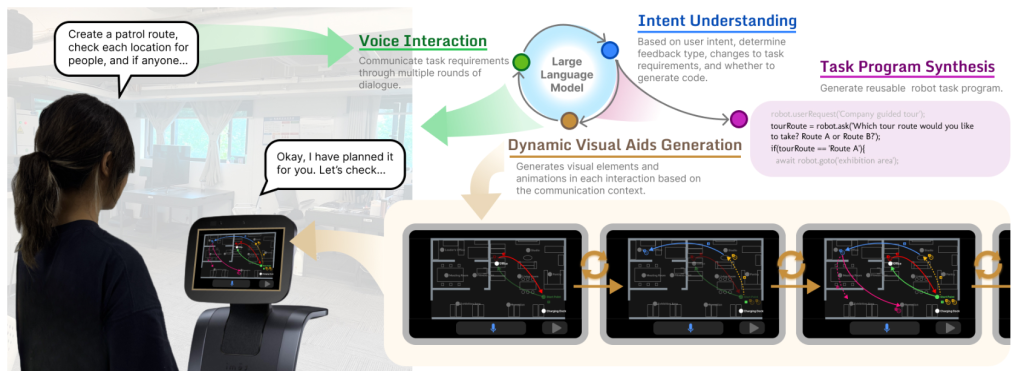 This work investigates the integration of generative visual aids in human-robot task communication. We developed GenComUI, a system powered by large language models (LLMs) that dynamically generates contextual visual aids—such as map annotations, path indicators, and animations—to support verbal task communication and facilitate the generation of customized task programs for the robot. This system was informed by a formative study that examined how humans use external visual tools to assist verbal communication in spatial tasks. To evaluate its effectiveness, we conducted a user experiment (n = 20) comparing GenComUI with a voice-only baseline. The results demonstrate that generative visual aids, through both qualitative and quantitative analysis, enhance verbal task communication by providing continuous visual feedback, thus promoting natural and effective human-robot communication. Additionally, the study offers a set of design implications, emphasizing how dynamically generated visual aids can serve as an effective communication medium in human-robot interaction. These findings underscore the potential of generative visual aids to inform the design of more intuitive and effective human-robot communication, particularly for complex communication scenarios in human-robot interaction and LLM-based end-user development.[......]
继续阅读
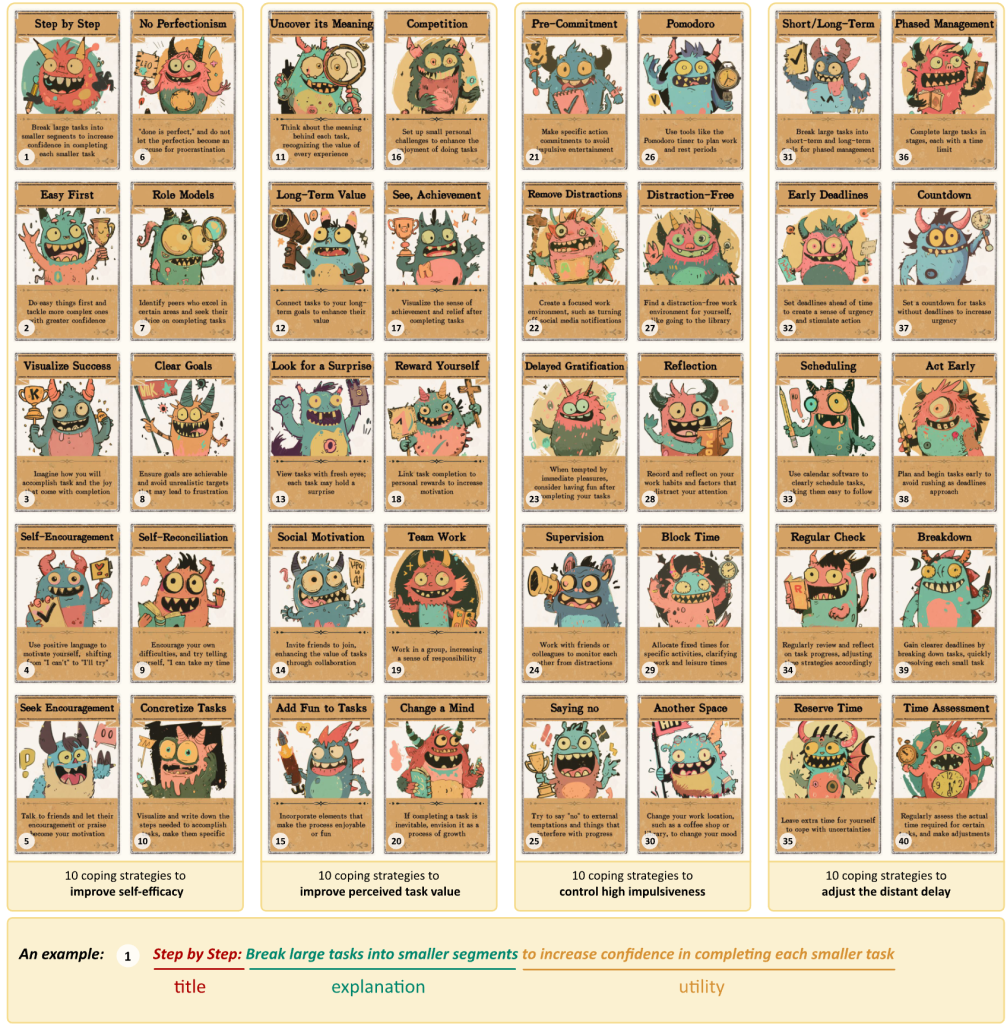 Procrastination, the voluntary delay of tasks despite potential negative consequences, has prompted numerous time and task management interventions in the HCI community. While these interventions have shown promise in addressing specific behaviors, psychological theories suggest that learning about procrastination itself may help individuals develop their own coping strategies and build mental resilience. However, little research has explored how to support this learning process through HCI approaches. We present ProcrastiMate, a text adventure game where players learn about procrastination’s causes and experiment with coping strategies by guiding in-game characters in managing relatable scenarios. Our field study with 27 participants revealed that ProcrastiMate facilitated learning and self-reflection while maintaining psychological distance, motivating players to integrate newly acquired knowledge in daily life. This paper contributes empirical insights on leveraging serious games to facilitate learning about procrastination and offers design implications for addressing psychological challenges through HCI approaches.[......]
继续阅读
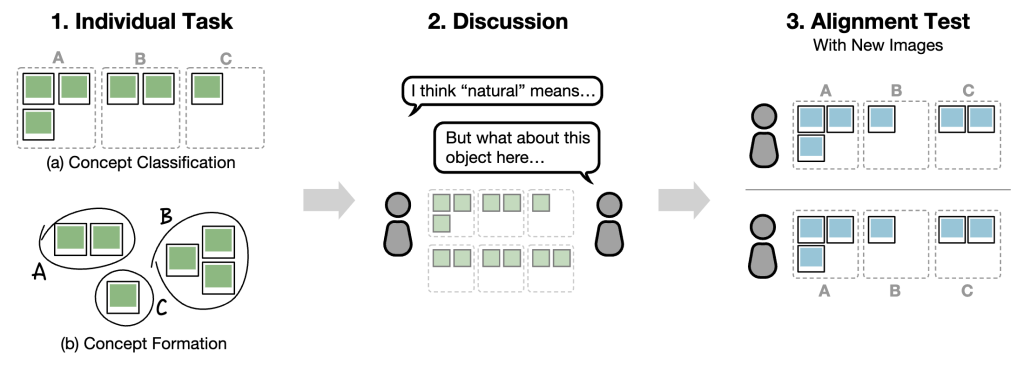 Concept alignment—building a shared understanding of concepts—is essential for human and human-agent communication. While large language models (LLMs) promise human-like dialogue capabilities for conversational agents, the lack of studies to understand people’s perceptions and expectations of concept alignment hinders the design of effective LLM agents. This paper presents results from two lab studies with human-human and human-agent pairs using a concept alignment task. Quantitative and qualitative analysis reveals and contextualizes potentially (un)helpful dialogue behaviors, how people perceived and adapted to the agent, as well as their preconceptions and expectations. Through this work, we demonstrate the co-adaptive and collaborative nature of concept alignment and identify potential design factors and their trade-offs, sketching the design space of concept alignment dialogues. We conclude by calling for designerly endeavors on understanding concept alignment with LLMs in context, as well as technical efforts to combine theory-informed and LLM-driven approaches. [......]
继续阅读
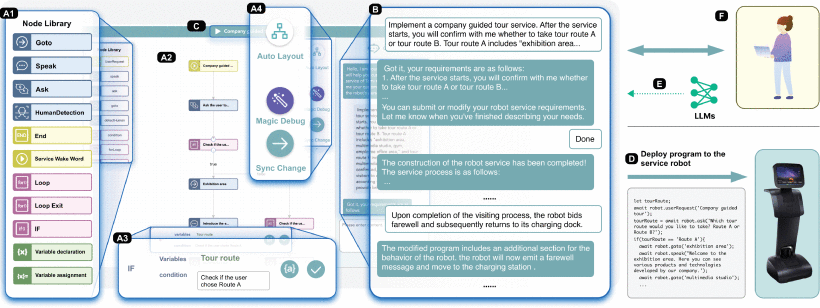 End-user development allows everyday users to tailor service robots or applications to their needs. One user-friendly approach is natural language programming. However, it encounters challenges such as an expansive user expression space and limited support for debugging and editing, which restrict its application in end-user programming. The emergence of large language models (LLMs) offers promising avenues for the translation and interpretation between human language instructions and the code executed by robots, but their application in end-user programming systems requires further study. We introduce Cocobo, a natural language programming system with interactive diagrams powered by LLMs. Cocobo employs LLMs to understand users’ authoring intentions, generate and explain robot programs, and facilitate the conversion between executable code and flowchart representations. Our user study shows that Cocobo has a low learning curve, enabling even users with zero coding experience to customize robot programs successfully.
[......]
End-user development allows everyday users to tailor service robots or applications to their needs. One user-friendly approach is natural language programming. However, it encounters challenges such as an expansive user expression space and limited support for debugging and editing, which restrict its application in end-user programming. The emergence of large language models (LLMs) offers promising avenues for the translation and interpretation between human language instructions and the code executed by robots, but their application in end-user programming systems requires further study. We introduce Cocobo, a natural language programming system with interactive diagrams powered by LLMs. Cocobo employs LLMs to understand users’ authoring intentions, generate and explain robot programs, and facilitate the conversion between executable code and flowchart representations. Our user study shows that Cocobo has a low learning curve, enabling even users with zero coding experience to customize robot programs successfully.
[......]继续阅读
 指出 “支持人在环路混合智能的交互设计” 这一类设计问题, 研究人在环路混合智能系统中交互设计的问题, 为相关设计, 技术与应用研究提供索引和参考. 从人在环路混合智能的概念和架构出发, 引出人在环路混合智能的交互设计; 基于对相关文献的整理, 总结常见界面构成和交互方式; 总结整理人在环路混合智能的生命周期. 指明了人在环路混合智能是需要用户交互的智能模型, 介绍了由用户, 人工智能算法, 用户接口构成的系统架构; 总结了针对不同数据类型的现有工作可能的交互方式; 分析了人在环路混合智能完整生命周期中的设计挑战, 根据现有文献提取关键界面构成, 提出了人在环路混合智能系统的设计建议; 提出了从智能系统, 用户, 设计师三方面建立设计方法论, 完善设计工具, 更有效地支持和推动人在环路混合智能系统的应用的建议.[......]
继续阅读
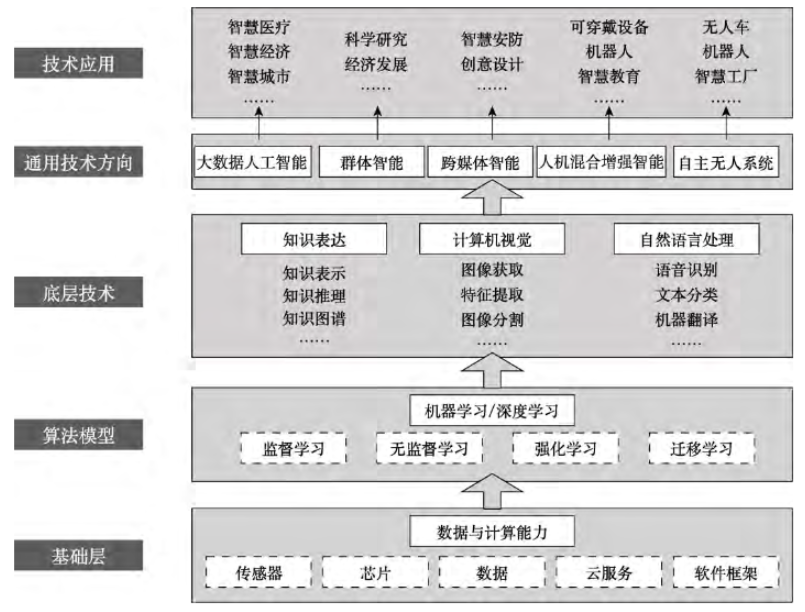 In the era of a new generation of artificial intelligence, this work aims to analyze and identify the characteristics and value of artificial intelligence products and service systems, indicates the future development trends, and provides references for related design, technology and application research. Starting from the concept of artificial intelligence (AI), the concepts of AI products and service systems is defined in this paper. Typical AI products and related re- search are reviewed and analyzed, and the key features and supporting technologies of artificial intelligence products are summarized. Then, this paper explores the typical service scenarios of AI products and reviews the current status of relevant research. Finally, the future trends and challenges are predict based on the previous analysis. This paper indicates that the typical characteristics of AI products include context awareness, adaptive learning, autonomous decision-making, proactive interaction and collaboration. Framework of supporting technologies of AI products is described, that data and computing power as base, algorithms as core, and multiple underlying technologies and general technologies supporting applications in various scenarios. The value that the service system of AI products can bring is analyzed in different scenarios. The future trends are predicted as the transformation from tech-driven to design driven, and the switch of perspective from single AI product to service system.
[......]
In the era of a new generation of artificial intelligence, this work aims to analyze and identify the characteristics and value of artificial intelligence products and service systems, indicates the future development trends, and provides references for related design, technology and application research. Starting from the concept of artificial intelligence (AI), the concepts of AI products and service systems is defined in this paper. Typical AI products and related re- search are reviewed and analyzed, and the key features and supporting technologies of artificial intelligence products are summarized. Then, this paper explores the typical service scenarios of AI products and reviews the current status of relevant research. Finally, the future trends and challenges are predict based on the previous analysis. This paper indicates that the typical characteristics of AI products include context awareness, adaptive learning, autonomous decision-making, proactive interaction and collaboration. Framework of supporting technologies of AI products is described, that data and computing power as base, algorithms as core, and multiple underlying technologies and general technologies supporting applications in various scenarios. The value that the service system of AI products can bring is analyzed in different scenarios. The future trends are predicted as the transformation from tech-driven to design driven, and the switch of perspective from single AI product to service system.
[......]继续阅读