跳到内容
 The shoulder joint plays a crucial role in the recovery of upper limb function. However, conventional wearable technologies employed for monitoring shoulder joint movements predominantly rely on inertial sensing units (IMUs), which may suffer alignment errors and compromise the freedom and wearability experienced by patients during their daily activities. This paper contributes in two facets, first, it presents the design, implementation, and technical evaluation of a new wearable system, a customized unilateral shoulder wrap that utilizes flexible and breathable textile sensors. Diverging from earlier studies, our system not only facilitates the monitoring of glenohumeral joint angles but also concurrently tracks the movement angles of the scapula. Secondly, to estimate joint angles, we propose a specific model called the Channel-Temporal Encoding Network (CTEN), which leverages Transformer and Long Short-Term Memory (LSTM) architectures. In a preliminary technical evaluation, the results demonstrate root mean square errors (RMSEs) of 2.24°and 1.13°for the glenohumeral joint and scapula, respectively. This study is intended to contribute to the development of more advanced wearables tailored for shoulder joint rehabilitation training.[......]
继续阅读
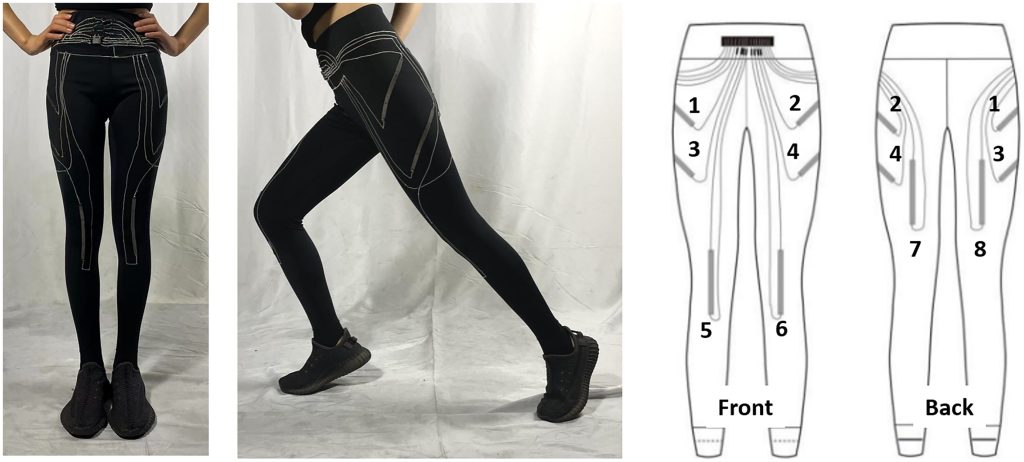 Running is a highly popular form of exercise, while incorrect running posture over an extended period can lead to severe knee injuries. Smart textiles have recently demonstrated significant potential for continuous motion monitoring. This study involved the design and development of a smart legging with a resistive textile sensor network to monitor lower body motion. The study consists of three main parts. Firstly, we tested textile sensors in terms of linearity and robustness to determine the basic sensor unit that can monitor the characteristics of running postures. Next, optimal sensor placement was determined through comparison experiments, and a sensor network was proposed. Finally, based on the LSTM model with data gathered from 6 participants, we developed the smart legging system that is capable of identifying three types of improper running postures and normal postures with 99.1% accuracy. The evaluation revealed that the smart legging system had the potential to help users adjust their running postures to prevent knee injury through continuous monitoring and multi-modal feedback.[......]
继续阅读
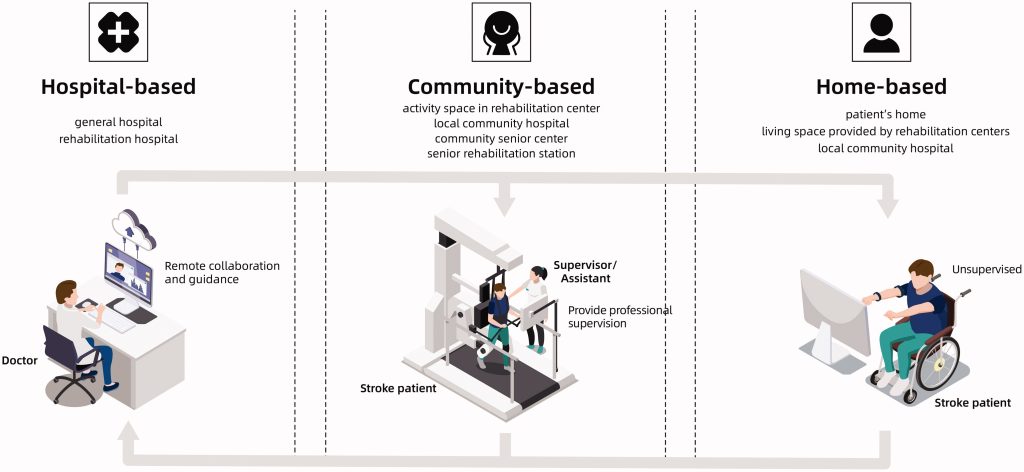 Stroke is a cardiovascular and cerebrovascular disease that affects the aged population at a high rate. Patients’ functional disabilities can be reduced with effective rehabilitation training. However, due to a lack of hospital resources and a social yearning for family contact, patients frequently discontinue rehabilitation training sessions and return home to their local community. Such a shift emphasizes the value of home and community-based rehabilitation, where patients can perform daily training with remote support from therapists. In this survey, the technologies that assist stroke rehabilitation will be discussed in following aspects: (1) technologies for home-based stroke rehabilitation; (2) technologies for community-based stroke rehabilitation; (3) technologies for therapist’s engagement in remote rehabilitation. A comprehensive overview of technologies that support home and community-based stroke rehabilitation was presented, as well as insights into future research themes.[......]
继续阅读
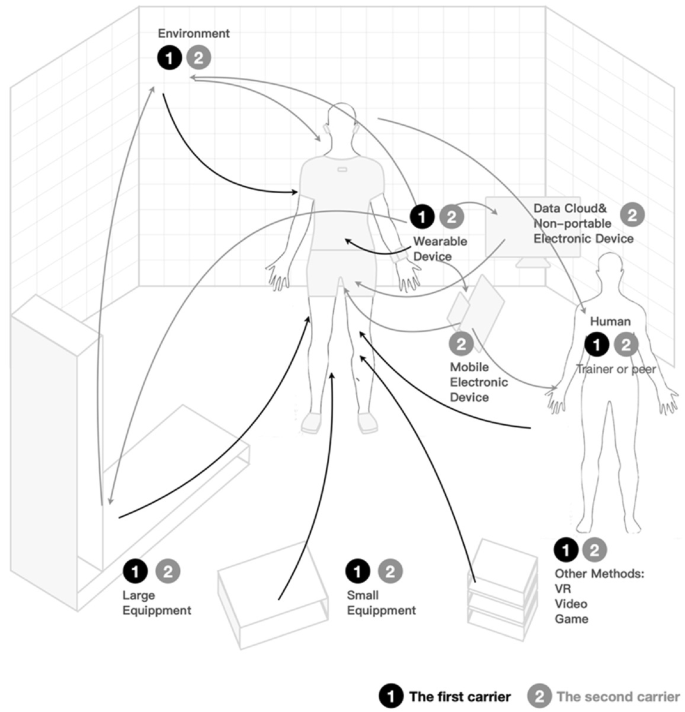 In this article, we focus on fitness workout scenarios. To examine the current practices, we first conducted a substantial user research, through the content analysis procedure we summarized insights regarding fitness purpose, essential data, psychological state, emotional changes and social habits. Subsequently, we generalized related design opportunities of improving the fitness experience and motivation to enhance the fitness performance and communication. Feedback and data representation have great potential to address the challenges, therefore we first proposed a design process for the feedback mode design of fitness workout, including the contextual information, feedback strategy, and realization ways. The feedback designs are implemented on a wearable augmented feedback system ‘FitSleeve’, focusing on individual and group scenarios separately. In group sessions, FitSleeve can demonstrate participants’ experience level, real-time heart rate zone and feedback regarding the correct movement execution. In individual sessions, FitSleeve can display the training progress and provide continuous encouragement. Finally, we evaluated FitSleeve by adopting the System Usability Scale, User Experience Questionnaire, Intrinsic Motivation Inventory and user subjective interviews. The findings indicate the potential of FitSleeve to improve the user experience and motivation of fitness participants.[......]
继续阅读